


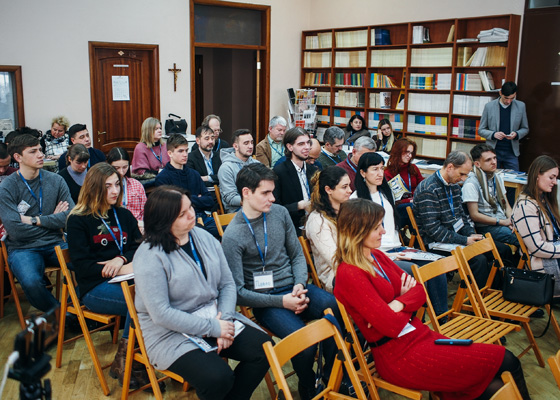
Is there a place for Christianity in Ukrainian universities, and if so, how will Christians get access? Where does the boundary between the secular and the religious lie in the education system? In a podium discussion called "Christianity at the University: Limits of the Possible" held on January 26, 2018 at the Institute of Religious Sciences St. Thomas Aquinas, in Kiev, the representatives of various denominations and educational institutions sought the balance between moral, spiritual and secular development of an individual. The meeting was held on the occasion of the 25th Anniversary of CCX Ukraine.
When it comes to religion and education, discussion usually develops along these lines: how to guarantee moral education and at the same time avoid confrontation and rejection of anything spiritual through the secular nature of the education system. The main mistake of these discussions may be the hope that the state has changed significantly during the years of independence, and 70% of Christian believers, according to sociological polls, participate in all aspects of modern life.
Unexpectedly, a new generation proved itself no less militant to the crossing of the secular and religious boundaries. This new generation continues to appeal to the concepts of human rights, freedom and European integration, believes Yuriy Reshetnikov, former Head of the Ukrainian State Committee on Nationalities and Religions (2009-2010). Therefore, in his opinion, it is necessary to understand how to deal with these concepts and maintain a balance, rather than hope for mass evangelization. The new law "On Education", which caused many comments, does not contain the principle of secularism, as its previous versions did. Reshetnikov explains this by the fact that nobody previously knew what it was and interpreted arbitrarily or as "the priests are not allowed here". However, the lack of the principle does not clarify the practical points: where does the boundary in the field of education lie.
"God has a sense of humor. In Soviet times I failed to complete my education four times because of my faith," recalls Anatoly Kalyuzhny, the senior pastor of the New Life Church. "And today I am sitting here and I can talk about integration of Christianity into the modern educational system. Great problems come to the surface where there is no Christianity to hold them back. If there is no Christianity, there is no morality, integrity of society, and harmony. But how it should happen is another question."
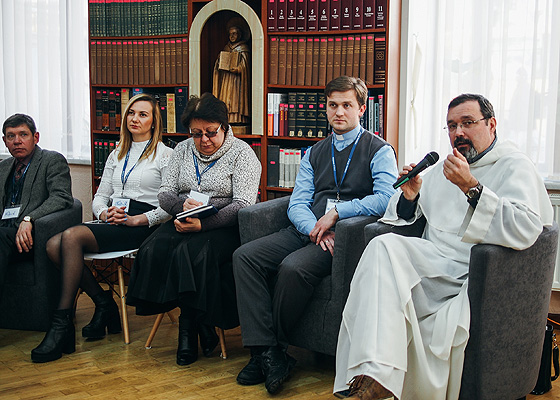
Other situations, such as the UCU(Ukrainian Catholic University) students’ claims and the chaotic protest of the students of NPDU(National Pedagogical Dragomanov University), who were forced to go to the prayer service on the occasion of Teachers’ Day, can be illustrative. These are just some signs from public debates on whether religion is needed at universities, schools, kindergartens, and in what form. Yuliya Nikolaychuk, Director of CCX Ukraine, believes that if the university is responsible for the vocational calling of people, Christianity seeks to answer the global call in life. The university can help young people become better human beings. "When dealing with students, the main issue that constantly arises is why there is so much misery in the world? And who can answer it, if not the Church?" she asked.
Despite the fact that the first universities in the 13th century were founded by ecclesiastical organizations, they always had autonomy, observes Wojciech Surowka, Director of the Institute of Religious Sciences St. Thomas Aquinas, Kiev. An educational institution has never been an integral part of the Church, like, for example, a parish; the Church could not directly influence its internal life, except for the issues of religion. "The word ‘universität’ has two main interpretations. The first is the coverage of all areas of knowledge, and the second is a cooperative search for truth. A university is a place where a student, together with a teacher, is looking for the truth whereas the Church seeks salvation. I am afraid that modern students perceive learning in a completely different way. The church rejoices when a person develops and does not engage in proselytism in education, but supports cooperation," he explains.
From the experience of Poland, there are two main ways in which Christianity is integrated into higher education institutions. The first is a faculty or a theology program that deals directly with these issues and has its own students. Additionally, each university has a compulsory subject - the philosophy of religion.The second is pastoral upbringing outside the educational process, which often takes the form of university chaplains or interviews with ministers, and inviting students to the service in their free time. Father Wojciech served as a chaplain for two years in the Polish city of Szczecin, but the students themselves came to him after meeting him.
Ukraine also has its own examples of the integration and cooperation of Christian organizations with secular universities or creation of their own educational institutions, especially after the official opportunity for religious educational institutions to obtain state accreditation. From the experience of CCX Ukraine, it is possible to conditionally distinguish between three ways of cooperation between Christianity and higher education, adds Yuliya Nikolaychuk. These are 1) "front entrance" through open lectures, events, and discussions; 2) encouragement of Christian students to informal engagement in different activities, for example, in the Student Council and 3) "informal" way through other activities in extra-curricular time.
There are other situations when a university and a religious organization organize joint educational programs, like the National Pedagogical Dragomanov University (NPDU) and the Christian center "Realis", shared Serhiy Timchenko, the Director of the center. "In the past, we created a separate leadership program for young ministers", he recalls. "Since the 90s, we have felt that society has become closed to religion, but at the same time, new opportunities appeared. Two academic programs were born after the speech of one famous theologian at an open event at NPDU."
At present, the representatives of various Christian confessions and religions study at NPDU in two programs: "Psychological counseling and chaplaincy" and "Socio-political ethics and theology". According to Timchenko, there are some key lessons in this example: 1) cooperation with the university is possible (almost for three years already) only when both sides are ready for it; 2) it is important to talk about expectations and potential problems beforehand and invest resources in development; 3) forms of cooperation may be different, but it is important to refrain from ideologization the process on both sides.
Another example is the new course called "Christian Pedagogics in Higher Education", which was officially opened two years ago, thanks to Irina Sidanich, Doctor of Pedagogical Sciences and professor of the University of Education Management. According to her, it is an opportunity to prepare state specialists in this field, who would be able to open new special courses, having their own PhDs, and hence teachers with a state diploma.
The Adventists in the city of Bucha near Kiev created a complete complex of state-run educational institutions of various levels. Its history began 18 years ago, with the support of two charitable foundations. During this time they officially developed a kindergarten, a secondary school and the Ukrainian Humanitarian Institute, currently with seven specialties. The main goal was to create a reputable educational alternative, so that Christians could also have an opportunity to get education founded on the right values. Today, representatives of other religions and non-religious people study at the institute because they are attracted by the outstanding level of education and atmosphere there. The system of education includes one mandatory course choice of spiritual and moral orientation each semester, as well as a ban on smoking, alcohol and physical/sex relationships on the institute campus. "We use the active student experience and develop it in every possible way," emphasizes the rector. "Students develop their own projects, which are included in the official educational process and are also evaluated. It brings up corporate responsibility, important skills and civic stance."
A striking example is also a well-known Ukrainian Catholic University (UCU) in L’viv, which also hosts students of various religious and secular backgrounds. They explain their success and popularity among Ukrainian youth by the fact that religion is not imposed; instead they create a space where every person can find their own solution.The only prohibition applies to actively propounding atheism, but a personal position cannot be criticized.The priest Dmitry Romanko, a student chaplain of the UCU, admits some misunderstanding among some students due to the balance of the religious and secular, but sees the importance in helping students understand what exactly is Christianity, "The word ‘university’ is understandable to us, but we often associate Christianity with something that is not important. The youth of western Ukraine often understand religion as a ritual. For me, Christianity is a daily decision not to steal, to be honest, not to support corruption, and so on. We often talk about the need to be salt, but do we think about the quality of the salt? If there are people who respect each other, then there will be no war between them, but a dialogue instead. They may not share another’s opinion, but they can perceive a different position and communicate, and then together look for opportunities."
"It is important not to be deceived by the common belief that the overwhelming majority of Ukrainians are religious," emphasized Liudmyla Filippovich, the head of the department of history of religions and practical religion study of the Department of Religion Study at the Institute of Philosophy of the National Academy of Sciences of Ukraine. "We should not take comfort in the thought that that there are multitudes of us. We must live according to the truth that exists and understand that not all nominally religious people are true believers. It is necessary to raise the question of the form in which we present and teach Christianity and work on quality," she assured. The professor herself has long experience in teaching religious studies at the National University of Kyiv-Mohyla Academy, where she introduces students to a living religious life. She embodies both the educational process (knowledge of the essence of religions), and spiritual influence, an impetus for reflection. According to her experience, it is important to focus on the consolidation and promotion of Christian initiatives, and not to wait for the state to guess about these intentions and meet us halfway.
"We continue to treat the state and the university as something ‘not ours’,” continued Yuriy Reshetnikov. "In fact, this is all ‘ours’ and the most effective strategy will be our involvement as Christians in all processes. It is obvious that believers are not born deans, vice-rectors and professors, but we should strive to occupy these posts. Where there are people who want change, the changes take place." The participants of the discussion are certain that the Church may be a resource of speakers and teachers for the education system, but the main thing is not to forget about the key question: "Is today's Church a place that young people would like to come to?"
The source: Religious Information Service of Ukraine (Tetyana Kalenichenko).